
Safe Splash · Parent guide · Ages 3-5
How to Teach Pool Safety to Preschoolers
Simple pool rules kids can remember, plus the safety layers grown-ups need to know.
Start here
How do you teach pool safety to a preschooler?
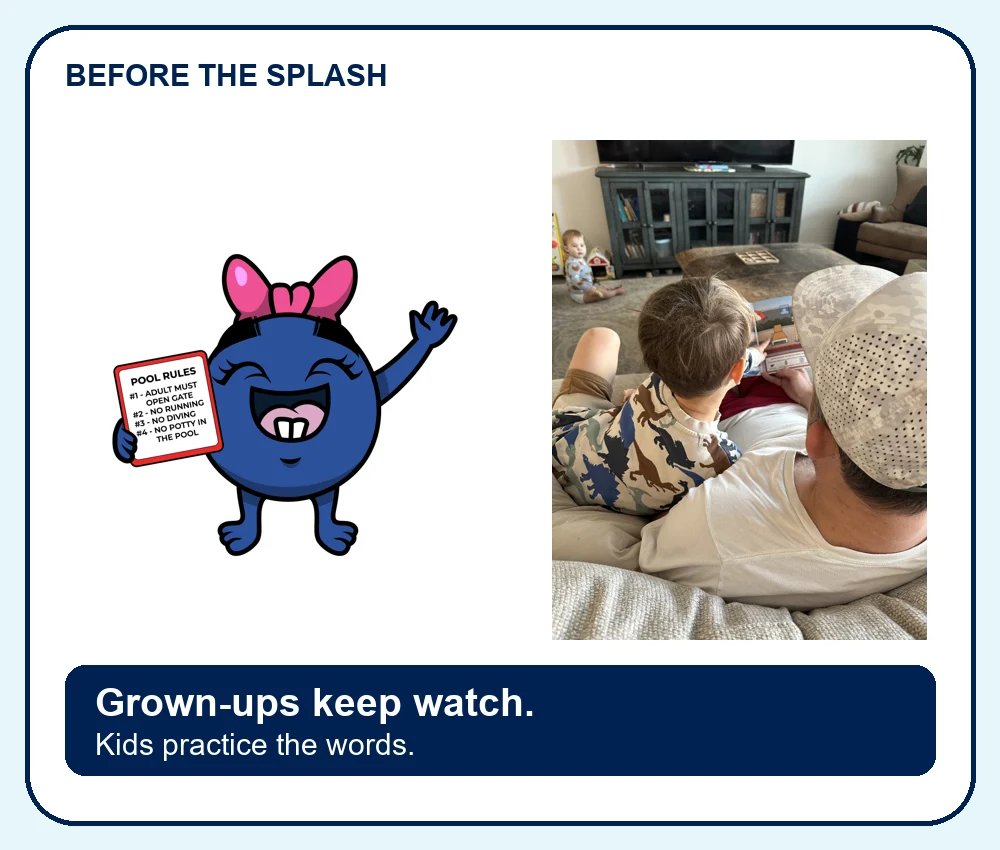
Teach pool safety to a preschooler with a few short phrases you can say the same way each time. Start on dry land: model waiting for a grown-up, walking and calling for help, then repeat the phrases before every swim. At the pool, the supervising adult stays close and guides each action. Remembering rules does not make a preschooler responsible for water safety; adult supervision, barriers, swim instruction and other protective layers still matter.
The Pool Safety Translator
What grown-ups do.
What preschoolers can remember.
Match the adult responsibility to a few words you can repeat. PRKB wrote the child phrases and practice prompts; the linked sources support the adult principles.
| Safety principle | Grown-up responsibility | Child phrase | Practice it |
|---|---|---|---|
| Adult-controlled pool access | Grown-up responsibilityAdults control and secure access to the pool. Establish the supervising adult before opening access, and keep the barrier secured between swims. Following this routine does not replace close supervision or the other safety layers. Adult guidance: Pool Safely · CDC | Say togetherGrown-ups open pool doors and gates. | Practice on dry landOn dry land, point to a pretend gate and ask, 'Who opens it?' Say, 'Grown-ups.' Do not let a child operate or test a real pool gate. |
| Ask, then wait for permission | Grown-up responsibilityControl access to water and be ready beside your child before giving permission to enter. A child's promise to wait is no replacement for a secured barrier. Adult guidance: AAP swim lessons · Pool Safely | Say togetherI ask and wait for my grown-up to say yes. | Practice on dry landAway from water, make a pretend entrance with a towel. Practice asking, waiting together and looking to the adult, then walking through together after a clear yes. |
| Close, constant supervision | Grown-up responsibilityGive young children and weak swimmers close, continuous attention within arm's reach. For a young child in the pool, join them in the water; take them with you if you leave. A lifeguard does not take over your responsibility. | Say togetherI stay with my pool grown-up. | Practice on dry landOn dry land, name the adult who will stay with your child. Stand together and say the phrase. The adult chooses and maintains the distance. |
| Walking and gentle play | Grown-up responsibilityModel walking, follow posted pool rules and guide gentle play without pushing. 'Kind hands' is PRKB's reminder for gentle behavior, not an official safety quotation. Follow lifeguard directions and keep the rehearsal on dry land, not beside water. Adult guidance: AAP water parks · Red Cross | Say togetherI use walking feet and kind hands. | Practice on dry landSay, 'Show me your walking feet.' Take three slow steps together in a clear indoor space. Then show gentle hands resting on your own knees, without pushing anyone. |
| Plan an appropriate way in and out | Grown-up responsibilityChoose the pool's permitted entry and exit with the child and provide hands-on help as needed. Use formal swim instruction to develop exit skills. This phrase is a PRKB teaching reminder, not a test of independent ability. Adult guidance: AAP swim lessons · AAP water parks | Say togetherI get in and out with my grown-up. | Practice on dry landPoint to pretend steps in a picture. At the pool, the adult identifies the real exit while staying with the child. No independent entry, jumping or diving drill. |
| Get help without entering water | Grown-up responsibilityIf someone is in trouble, adults respond and summon emergency help. A preschooler's job is to call a grown-up immediately and stay out of the water; never ask a young child to attempt a rescue. Adult guidance: Red Cross | Say togetherIf someone needs help, I call a grown-up and stay out of the water. | Practice on dry landUse a toy on dry land: 'Someone needs help. What do you say?' Practice calling 'Grown-up, help!' No water, reaching or throwing exercise. |
Preschoolers
Six pool phrases to say together
Choose one to start. Repeat before each swim, then model the behavior while staying with your child.
Grown-ups open pool doors and gates.
For the grown-up: Adults control and secure access to the pool. Establish the supervising adult before opening access, and keep the barrier secured between swims. Following this routine does not replace close supervision or the other safety layers.
Short practice: On dry land, point to a pretend gate and ask, 'Who opens it?' Say, 'Grown-ups.' Do not let a child operate or test a real pool gate.
Adult guidance: Pool Safely · CDC
I ask and wait for my grown-up to say yes.
For the grown-up: Control access to water and be ready beside your child before giving permission to enter. A child's promise to wait is no replacement for a secured barrier.
Short practice: Away from water, make a pretend entrance with a towel. Practice asking, waiting together and looking to the adult, then walking through together after a clear yes.
Adult guidance: AAP swim lessons · Pool Safely
I stay with my pool grown-up.
For the grown-up: Give young children and weak swimmers close, continuous attention within arm's reach. For a young child in the pool, join them in the water; take them with you if you leave. A lifeguard does not take over your responsibility.
Short practice: On dry land, name the adult who will stay with your child. Stand together and say the phrase. The adult chooses and maintains the distance.
I use walking feet and kind hands.
For the grown-up: Model walking, follow posted pool rules and guide gentle play without pushing. 'Kind hands' is PRKB's reminder for gentle behavior, not an official safety quotation. Follow lifeguard directions and keep the rehearsal on dry land, not beside water.
Short practice: Say, 'Show me your walking feet.' Take three slow steps together in a clear indoor space. Then show gentle hands resting on your own knees, without pushing anyone.
Adult guidance: AAP water parks · Red Cross
I get in and out with my grown-up.
For the grown-up: Choose the pool's permitted entry and exit with the child and provide hands-on help as needed. Use formal swim instruction to develop exit skills. This phrase is a PRKB teaching reminder, not a test of independent ability.
Short practice: Point to pretend steps in a picture. At the pool, the adult identifies the real exit while staying with the child. No independent entry, jumping or diving drill.
Adult guidance: AAP swim lessons · AAP water parks
If someone needs help, I call a grown-up and stay out of the water.
For the grown-up: If someone is in trouble, adults respond and summon emergency help. A preschooler's job is to call a grown-up immediately and stay out of the water; never ask a young child to attempt a rescue.
Short practice: Use a toy on dry land: 'Someone needs help. What do you say?' Practice calling 'Grown-up, help!' No water, reaching or throwing exercise.
Adult guidance: Red Cross
Practice these before pool time
These are PRKB conversation activities, not swim lessons or ability tests. Start in a dry room away from water. At a real pool, keep the adult supervision layers in place throughout.
About 30 seconds
Show me your walking feet
Walk slowly together across a clear indoor space, then rest gentle hands on your own knees. Let your child show the same actions. Say the walking-and-kind-hands phrase once more before pool time.
See the matching pool phraseAbout 30 seconds
Who is your pool grown-up?
Name the supervising adult and stand together. If the adult changes, introduce the next adult to your child after the adults explicitly agree on the handoff.
See the matching pool phraseAbout 1 minute
Wait for the yes
Use a towel as a pretend doorway far from water. Wait beside your child, say yes, then walk through together. Repeat without rewarding speed.
See the matching pool phraseAbout 1 minute
Point to the way out
Use a drawing of pool steps. Point together and say, 'We go out together.' At the real pool, the adult chooses the exit and helps; this is not a swimming challenge.
See the matching pool phraseAbout 30 seconds
Call for a grown-up
Pretend a toy needs help in a dry room. Have your child call to the adult who is right there. Never place a person or toy in water to rehearse an emergency.
See the matching pool phraseBefore we swim
The grown-up pool day checklist
Use this to plan the adult layers, not to certify a pool or a child as safe. Local requirements may add obligations.
- Stay within arm's reach of young children and weak swimmers. Join young children in the water and take them with you when leaving.
Adult guidance: AAP
- Keep phones, reading, alcohol and other distractions out of the supervising adult's watch period.
Adult guidance: CDC
- Check pool access: four-sided fencing, at least 4 feet high, separating pool and house, with a self-closing, self-latching gate.
Adult guidance: CDC · Pool Safely
- Where a life jacket is needed, check U.S. Coast Guard approval, child size, fit, condition and suitability for the activity.
Adult guidance: Coast Guard · AAP
- Keep children away from drains. Do not use a pool or spa with a loose, broken or missing drain cover.
Adult guidance: Pool Safely
- Know the location, emergency call plan and rescue equipment. Keep adult CPR training current.
Adult guidance: Red Cross · Pool Safely
- After swimming, secure access again and remove pool toys that may tempt a child to return.
Adult guidance: CDC
Four things to avoid relying on
“My child has lessons, so I can watch less closely.”
Lessons can lower drowning risk, but do not make a child drown-proof. Keep the same close, constant supervision.
Adult guidance: CDC · AAP swim lessons
“Water wings or pool toys are safety equipment.”
Inflatable toys and water wings are not substitutes for an appropriate life jacket. They do not remove the need for an adult beside a young child.
“A lifeguard means someone else is watching my child.”
A lifeguard is an additional layer. You or another responsible adult still supervises your child.
Adult guidance: Red Cross
“I can listen for splashing while I do something else.”
Drowning can happen quickly and quietly. Watch continuously; do not rely on sound to alert you.
Adult guidance: CDC
Plan for real pool days
Grown-up guidance
Pool parties: name the Water Watcher
At a busy gathering, explicitly assign a responsible adult to focused supervision. No phone use or socializing during the watch. Agree on the next watcher before taking a break; pass the responsibility directly. AAP gives 15-20 minutes as an example rotation to support alertness, not permission to leave a child unwatched. Each young child still needs close supervision within arm's reach; one watcher across a busy pool may not provide that. Keep barriers, swim skills and other layers in place.
Adult guidance: AAP · Pool Safely
Grown-up guidance
Someone else's pool: check access before settling in
At another home, rental or hotel, look for pools and spas and ask how children could reach them. Check gates and doors rather than assuming a host has secured them. Name the supervising adult, identify the pool's exit and keep your child close while you learn the setting. During non-swim time, block access; at swim time, maintain close supervision. If the setting cannot support your safety plan, choose another activity.
Adult guidance: AAP travel · CDC
For caregivers: act immediately
If a child is missing, check the water first
When a child is missing near a pool or other water, check the pool, spa and other water first. Alert the lifeguard if present and shout for help if someone is in trouble. Adults handle the emergency response; ask someone to call emergency services. A preschooler should call a grown-up immediately and stay out of the water.
Adult guidance: Red Cross
Grown-up guidance
Swim lessons are one protective layer
Formal lessons can reduce drowning risk. AAP advises choosing when to start based on the child's readiness, comfort, development and exposure to water, with a pediatrician's input where needed. Choose qualified instruction that includes water-safety habits and getting out of the water. Lessons do not make children drown-proof, and supervision remains necessary.
Adult guidance: AAP swim lessons · CDC
Grown-up guidance
Life jackets and floaties are different
AAP recommends properly fitted, U.S. Coast Guard-approved life jackets for children in, on or near natural water, and for children without strong swimming skills at pools or water parks. Check the label for weight, size and intended use, follow fitting instructions and inspect condition. Water wings and inflatable toys are not protective substitutes. Evaluate the actual device's approval and fit rather than assuming a brand or product shape is approved. A life jacket still requires adult supervision.
Adult guidance: AAP · Coast Guard · CDC
Grown-up guidance
Prepare adults before an emergency
Learn CPR and safe response through current training. Know how to summon emergency services and where rescue equipment is kept. Red Cross's 'reach or throw, don't go' belongs in age-appropriate rescue education; this guide asks preschoolers only to call a grown-up and stay out of the water. This page does not teach CPR or water-rescue technique.
Adult guidance: Red Cross · Pool Safely
Make the conversation fit your child
Younger preschoolers
Try one phrase and show one action. Point, model or use a picture instead of expecting a spoken answer. Keep practice brief and repeat it another day.
Older preschoolers
Ask your child to explain a phrase to a toy or choose which reminder to say first. Keep the same adult supervision and access controls. A good explanation is not a safety qualification.
Age adaptations are editorial suggestions. Children vary; readiness for swim lessons needs an individual assessment.
Adult guidance: AAP swim lessons
Optional storytime reinforcement
Keep the conversation going with Hiccup
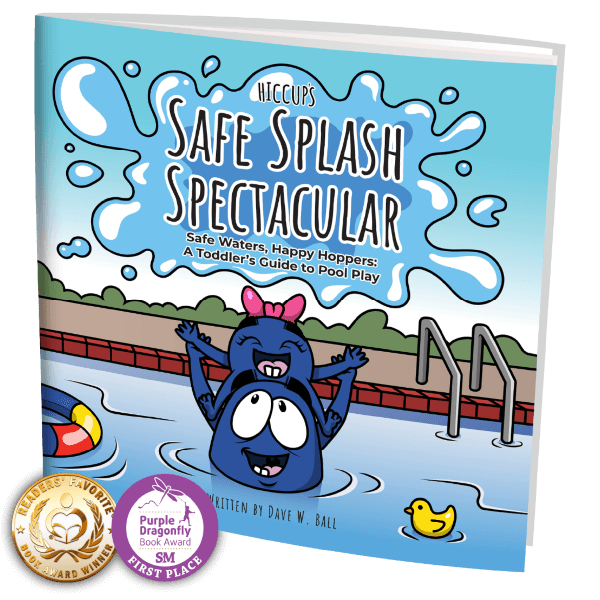
Hiccup's Safe Splash Spectacular: Safe Waters, Happy Hoppers uses rhymes and colorful Hiccups illustrations to start a caregiver-child conversation about pool rules. Share a page on dry land, then repeat one phrase from this guide before pool time.
The book is conversation support. It does not replace supervision, barriers, swim instruction, appropriate life jackets or CPR readiness.
Explore Safe Splash SpectacularFree · Two Letter pages · No email
Safe Splash Pool Safety Pack
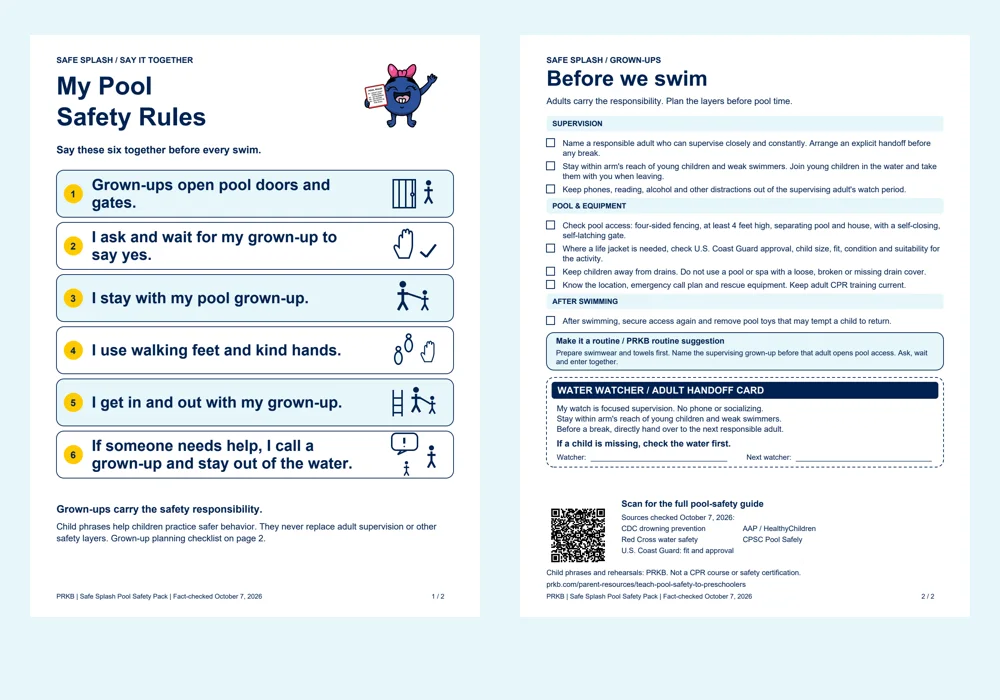
A big-print child poster for saying the six phrases together. A separate grown-up checklist with an integrated Water Watcher card for explicit handoffs.
Keep the child page on the fridge or in the pool bag. Use the adult page to plan before leaving home. Both pages link back to the full, sourced guide.
Download the free safety packPrint at 100% on U.S. Letter. Readable in color or grayscale. Available even when email signup is unavailable.
Parent questions
What pool rules can I teach a 3-year-old?
Start with 'I stay with my pool grown-up' and 'I ask and wait for my grown-up to say yes.' Model one action on dry land. Add the other phrases gradually. The adult controls access and supervision even when the child remembers the words.
Adult guidance: Red Cross · AAP swim lessons
How do I teach a 4- or 5-year-old without making it scary?
Use a calm, short rehearsal and praise the practice. Ask the child to show walking feet or point to a pretend exit. Let an older preschooler explain the phrase back, while keeping the adult responsibilities the same. These are PRKB teaching suggestions, not proof that the child can stay safe independently.
How close should I stay to my preschooler in a pool?
Stay within arm's reach of a young child or weak swimmer and give continuous attention. AAP calls this touch supervision. Join young children in the water, and take them with you when leaving.
Adult guidance: AAP
What if my child forgets a rule?
Stay beside your child, calmly guide the action and repeat one phrase. Do not use a remembered rule, sticker or completed checklist as permission to reduce supervision. Remembering words and swimming ability are different things.
What should a preschooler do if someone needs help in the water?
Call a grown-up immediately and stay out of the water. Adults handle rescue and emergency calls. Do not ask a preschooler to jump in, reach into water or throw equipment as a practice exercise.
Adult guidance: Red Cross
Can I use the pack without buying a book or giving an email?
Yes. The two-page Safe Splash Pool Safety Pack is a direct free download. Use the child page for conversation and the grown-up page for planning. The pack supports, and never replaces, the adult safety layers.
Sources for the adult safety guidance
Follow the contextual source links for each principle. The preschool wording is PRKB's translation, not a quotation or endorsement by these organizations.
- CDC: Preventing Drowning
Constant supervision, barriers, lessons, flotation and quiet drowning.
- AAP: Drowning Prevention for Curious Toddlers
Touch supervision, pool access, life jackets and Water Watcher handoffs.
- AAP: Swim Lessons for Children
Individual readiness, permission to enter and continued supervision.
- American Red Cross: Water Safety
Missing-child response, emergency readiness and layers of protection.
- CPSC Pool Safely: Safety Tips
Barriers, drains, designated supervision and CPR certification.
- U.S. Coast Guard: Life Jacket Wear
Approval, size, fit, condition and intended activity.
- AAP: Water Park Safety for Families
Walking, posted rules and lifeguard directions.
- AAP: Hotel Safety for Young Children
Vacation water access and touch supervision.